New Colors and Convertible Option Available for 2012 Shelby 350

2012 Shelby GT350 Convertible

2012 Shelby GT350 Convertible

The 2011 Shelby GT350 followed nearly the same philosophy as the Ford Model T. You could get it in any color you want as long as it was white with blue stripes. That’s changing for 2012, as Shelby will also be offering the GT350 in Race Red and Kona Blue. A convertible option will be available, as well. In fact, this is the first time Shelby has built a drop-top GT350 since 1970.

The 2012 GT350 will offer up identical performance as the 2011 model, although one could argue that it didn’t need an upgrade in the first place. Customers can choose between the 430-horsepower base model or opt for either 525- or 624-horsepower versions. Additional upgrades include a full body kit, Cragar wheels, larger brakes, sport suspension and more. The convertible also comes with the option of a light bar.

The Toughest Truck Out There!

2011 Ford F-Series Super Duty Regains Towing Leadership with Production Upgrades; Leads in Customer Satisfaction

*Super Duty regains conventional towing leadership
*Customer satisfaction of 83 percent tops all competitors
*Half of heavy duty truck segment goes to Super Duty

Production begins this week on Ford F-Series Super Duty trucks with upgraded towing capacity. The beefed-up frame and hitch return the industry’s best-selling heavy-duty truck to the head of the pack in conventional trailer towing.

Ford F-350 and F-450 Super Duty trucks with the 6.7-liter Power Stroke® V-8 diesel engine and dual rear wheels now can tow an industry-best 17,500 pounds. That’s 1,000 pounds more than the Chevrolet Silverado and GMC Sierra 4×2 and 500 pounds more than the Silverado and Sierra 4×4.

Furthermore, Super Duty’s latest improvements arrive at a time when its customer satisfaction score – 83 percent – is the best in the industry for heavy-duty trucks; and when Super Duty’s market share is the highest in a decade.

“Super Duty stays on top because of our ongoing engineering work and analysis of extensive field data,” said Rob Stevens, chief engineer of the 2011 Ford F-Series Super Duty. “We keep pushing to deliver the best-in-class attributes our customers demand.”

A look at the revised maximum conventional trailer tow ratings for the 2011 Ford F-Series Super Duty:

Ford Super Duty model
Drive
Maximum conventional trailer towing (pounds)
Advantage over nearest competitor (pounds)

F-250 / F-350 SRW
Drive-4×2/4×4
Maximum conventional trailer towing (pounds)- 14,000/14,000
Advantage over nearest competitor (pounds)- 1,000/1,000

F-350 DRW
Drive- 4×2/4×4
Maximum conventional trailer towing (pounds)-17,500/17,500
Advantage over nearest competitor (pounds)-1,000/500

F-450 DRW
Drive-4×4
Maximum conventional trailer towing (pounds)-17,500
Advantage over nearest competitor (pounds)- No Competitor

The additional 1,500 pounds represent an increase of more than 9 percent compared with the Super Duty at launch in April, 2010.

Higher-strength steel in a frame crossmember and an upgraded trailer hitch give the truck the additional towing capacity. Additionally, these actions boosted the F-350 DRW 4×2 pickup maximum payload to 7,070 pounds and maximum fifth-wheel towing to 22,600 pounds, each best-in-class ratings by 435 pounds and 900 pounds, respectively.

The hardware upgrades to the Super Duty complement software upgrades to the powertrain control system of the new Ford-engineered 6.7-liter Power Stroke V8 turbocharged diesel to make towing even easier.

The Power Stroke delivers best-in-class 800 lb.-ft. of torque and 400 horsepower. In an industry-first customer loyalty program, Ford provided the power upgrades free of charge to all “first-in” buyers of the 2011 Super Duty diesel pickup.

Waldorf Ford Weekly News Video — ASK ASHLEY!

http://www.waldorfford.com and Ashley launch a totally new segment called “Ask Ashley” where Ashley responds viewers emails, postings on YouTube or on our Facebook page. We will do these on a regular basis so keep those questions coming.
Vodpod videos no longer available.

✲ ✲ ✲ SNOW ✲ ✲ ✲

Interesting facts about snow!!

Given the current weather, I felt it appropriate to give you a few fun facts about snow!

✲ 1) Largest Snowflake

According to the Guinness Book of World Records, on this date in 1887 the largest snowflake ever observed fell in Fort Keogh, Montana. Supposedly this snowflake was 15 inches wide and 8 inches thick! Not surprisingly there aren’t any photographs of this giant snowflake, so basically we’re just taking the word of the rancher who claims he found this monster.

✲ 2) Fastest Temperature Drop:

RapidCity-pic-7 []

South Dakota has some strange weather due to the Chinooks, and Rapid City (about 45 min from Spearfish) holds the record for the fastest temperature drop ever recorded. On January 22, 1943, the same day as the strange weather in Spearfish above, the temperature plummeted 27°C (47°F) in 5 minutes from 16°C (60°F) to -11°C (13°F), and this set the record for fastest drop in temperature ever recorded.

✲ 3) Highest Snowfall in North America:

Mt-Baker--Table-1925

Between July 1, 1998 and June 30, 1999, 29.0 meters, (1140 in) of snow fell on Mount Baker which is located in Washington State, United States. When the Mt. Baker Ski Area reported the figure it was investigated by the National Climate Extremes Committee and they voted unanimously to accept the number. The previous record was 1,122 inches on Mt. Rainer (150 miles south of Mt. Baker) in 1971. The Pacific Northwest has large quantities of snowfall in the mountains and that is for a few reasons. Seattle has a well-earned reputation for raining often, and when all of the moisture-filled clouds from the Pacific hit the mountains they begin to dump their precipitation on the slopes. Seattle is at a low elevation so it is frequently too warm for snow, but it is often below freezing at elevations higher than 4,000 feet which leads to the high snowfall in the mountains.

✲ 4) How a snowflake forms

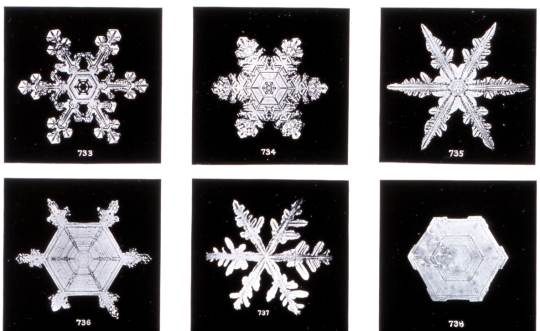
 Snowflakes form when atmospheric water is cooled below its freezing point by either an invasion of cold air, or a sudden updraft into cooler elevations. The water enters a super-cooled state and snowflake formation takes place upon air-borne microscopic dust particles acting as nuclei for condensation. As snow crystals form they take on a hexagonal shape with an infinite number of variations.

The temperature at which a crystal forms, and to a lesser extent the humidity of the air, determine the basic shape. The many things that happen to snow crystals as they fall, such as collisions, partial melting and colliding with water drops that freeze to them, create even more shapes. Irregular crystals with no easily identifiable form or a combination of more than one form are the most common, and only 1 per cent of flakes are thought to be symmetrical.

Snow crystals are six-sided because of the shape of the water molecule which consists of two atoms of hydrogen and one atom of oxygen. This construction is formed in the shape of a triangle with three equal sides. When crystallisation takes place, each new ice crystal bud is formed at an angle of 60 degrees from the hub or apex of the triangle. Continuing this process, the hexagon is formed when six of these molecular triangles are completed and this becomes the framework for further growth.

✲ 5) Worlds tallest snowman

Take 9,000,000 pounds of snow, two 4 foot wreathes to use as eyes, 6 feet of chicken wire and muslin for the carrot nose, 6 automobile tires as the mouth, a 20 foot fleece hat, a 120 foot fleece scarf, 3 more tires for the buttons and  two 10 foot trees for the arms, assemble, and you have the world’s largest snowman. The snowman went by the name of Angus and was built in Bethel, Maine in 1999. He officially melted on June 10, 1999.

Angus was a mountain of a snowman, measuring 113 feet 7 inches tall.


✲ 6) Longest Icicle

I couldn’t find any definite answers to what the longest icicle. There is a 100 ft Icicle that is being inspected as we speak but no definites yet. But here are a few pictures of some really big ones!

✲ 7) Most snow angels in one place.

On March 28, 2007, Guinness World Records confirmed that North Dakota holds the world record for the most snow angels made simultaneously in one place. The record breaking event occurred February 17, 2007 when 8,962 snow angels were created by people waving their arms while lying in the snow covering the state Capitol grounds in Bismarck.

NOW to warm  you up, here is a fun fact about the largest cup of hot chocolate!

The giant mug was filled with 487 gallons of hot chocolate, covered with bags of marshmallows and heated to a perfect temperature of 120 degrees. Between 6,000 and 10,000 cups of delicious hot chocolate were distributed to passers-by, for free.

It seems hot chocolate is one of the best ways to stock up on vitamin-D, during winter. Who knew?

Stay Warm!

Mustang brings back The Boss for 2012

Coming in the Spring of 2012

The Boss Mustang is hitting the streets once again in the form of the track-oriented Boss 302 unveiled at the Rolex Historic Races at Laguna Seca. According to the company, the 2012 Mustang Boss 302 is the “quickest, best-handling straight-production Mustang ever offered by Ford.” It pays homage to its track-star forebears by lightening and strengthening key components, juicing up the engine, and wrapping it all in the vintage color schemes that Boss Mustangs are known for still today.

Aerodynamic changes include a deeper front air dam and a rear spoiler. Not accidentally, the changes stylistically connect the new car to its predecessor, right down to the livery, including Competition Orange, Performance White, Kona Blue, Yellow Blaze, or Race Red. These are offset by white or black C-stripes and a matching roof.

Inside, however, the 2012 Boss 302 couldn’t be less like the original—today’s UPS trucks come with more creature comforts than most track-oriented muscle cars from the late 1960s.

The new Boss models receive an Alcantara-covered steering wheel, dark metallic dash and door panels, a black shift knob, and cloth seats with “suede-like” center inserts.

 The GT500’s Recaro front bucket seats are optional. Eleven pounds of sound-deadening material are missing, to allow more of the engine’s uniquely tuned exhaust sound to fill the cabin.

What a Difference Four Decades can Make!

While the ’69 Boss 302 may be the stuff of legends, by modern standards, its (claimed) 290 hp at 5800 and 290 lb-ft of torque at 4300 rpm is less power and only marginally more torque than the 2011 Mustang’s V-6, never mind the brawny V-8 powering the GT. In the Boss, the GT’s 5.0-liter is upgraded with new intake runners, revised camshafts, and more aggressive engine controls, raising output from the 412 hp to 440. Torque drops slightly, from 390 lb-ft to 380.

The power gets to the wheels via a short-throw six-speed manual transmission with a beefed-up clutch, while the rear end packs a 3.73:1 axle ratio and carbon-fiber plates within the limited-slip differential.

One of the most interesting features of the 2012 Boss 302 is its quad exhaust system, developed to give the car a unique sound.

The two primary pipes exiting the rear handle most of the exhaust gases, while two smaller pipes branch off from the exhaust crossover and exit discreetly along the lower body sides, just in front of the rear wheels, sending gases through a set of metal discs that generate unique sounds. Should the owner live somewhere with more lax noise regulations, the plates can easily be removed in favor of aftermarket dump valves.

In its quest to turn the Boss 302 into what it calls “a race car with a license plate,” Ford upgraded the GT’s suspension with stiffer springs and bushings, adjustable shocks, and a thicker rear anti-roll bar. Ride height drops 11 mm up front and 1 in the rear. As with the original Boss 302, shock adjustment is done manually—in this case via a screw atop each shock tower—among five stiffness settings.

The Mustang’s electric steering system has also been reworked, giving the driver a choice of three feedback settings—Comfort, Normal, and Sport. Traction and stability-control systems are reprogrammed to offer a choice of full engagement, no engagement at all, or an intermediate sport mode.

The 302’s black-painted wheels measure 19 by 9 inches in front and 19 by 9.5 in back; wrapped by 255/40 front and 285/35 rear Pirelli PZeros. The GT’s optional Brembo brakes are upgraded with high-performance pads and unique ABS calibration.

Ford’s performance claims for the 2012 Boss 302 include cornering capability in excess of 1.0 g, shorter stopping distances than provided by the GT—even with its available brake upgrade—and a 155-mph top speed. Ford declined to provide acceleration figures, but the 302 should handily beat the 2011 Mustang GT’s marks of 4.6 seconds from standstill to 60 mph and 13.2 seconds through the quarter-mile at 109 mph. Whatever the time, it will certainly best the ’69 Boss 302’s 6.5 seconds to 60 and 14.9-second quarter-mile at 93 mph. (That seemed much faster back then.)

Lighter and Tighter: Laguna Seca Edition

Additionally, Ford is launching an even more exclusive “Boss 302 Laguna Seca” model for the harder-core buyer. It ditches the rear seat and some creature comforts while additionally stiffening the body and suspension, and carrying over the aerodynamics package from the Ford Racing Boss 302R almost unchanged.

The 2012 Mustang Boss 302 and 302 Laguna Seca hit dealerships sometime in 2011 at a price yet to be determined. Figure around $36,000 for the base 302 and upwards of $40,000 for the Laguna Seca. Considering that Ford isn’t having any trouble finding homes for its $50,000 Shelby GT500s, we expect the limited-edition Bosses to likewise go very quickly.

Waldorf Ford Weekly News Video — Charles County Humane Society

This week http://www.waldorfford.com and Ashley thought we would show you a little about one of the great organizations here in our county.

http://www.humanesocietycc.org is located in Waldorf on industrial drive just down the road from the DMV.
Vodpod videos no longer available.

Torture-tested Ford EcoBoost V6 engine torn down at Detroit Auto Show

 Torture-tested Ford EcoBoost V6 engine torn down at Detroit Auto Show

Teardown-intro

Ford Motor Co. made some history over the weekend when it did a complete engine tear-down and inspection of a “torture tested” 3.5-liter EcoBoost twin-turbo V-6 used in the latest F-150 at the 2011 North American International Auto Show.

Auto shows, like NAIAS, typically showcase the latest metal in fancy displays bathed in brilliant lights and staffed with beautiful spokesmodels. They’re about as far as you can get from the garages that all cars and trucks will eventually require a visit to for service and maintenance. But for an hour Saturday, Ford turned part of its spotless blue and white display space inside Detroit’s Cobo Hall into a service bay for the last chapter of the F-150 EcoBoost torture test.

Brown-Rahill-560

The front of the 3.5-liter EcoBoost V-6 prior to the start of the teardown in front of an estimated audience of more than 1,000 people at the 2011 Detroit auto show.

In case you’re one of the three or four people who haven’t been following the F-150 EcoBoost torture test story online, here’s a recap:

A production EcoBoost V-6 engine, serial number 448AA, was randomly selected off the assembly line at Ford’s Cleveland engine plant. The dual-overhead-cam power plant was shipped to dynamometer cell 36B in the Ford Dearborn engine labs and run for 300 hours to replicate the equivalent of 150,000 customer miles, including repeated temperature-shock runs when the engine was cooled to minus 20 degrees Fahrenheit and then heated to 235 degrees.

The engine was then shipped to Ford’s Kansas City truck plant and installed in an F-150 4X4 crew-cab pickup. It was driven to Nygaard Timber in Astoria, Ore., and put to work as a log skidder, dragging a total of 110,000 pounds of logs across the ground to demonstrate its 420 pounds-feet of torque.

Valvetrain-Exposed

The front engine cover, intake manifold and heads are removed from the engine to expose the valvetrain.

From there, the truck was driven across the country to Homestead Miami Speedway, where it was hooked up to a trailer carrying two of Richard Petty’s Ford Fusion racecars, a load of 11,300 pounds, and run continuously around the track for 24 hours, averaging 82 mph and covering 1,607 miles.

It was then taken to Davis Dam in Arizona, where it bested both the 5.3-liter Chevy Silverado V-8 and the Ram 5.7-liter Hemi V-8 in an uphill towing contest pulling 9,000 pounds up a 6 percent grade on Highway 68.

Finally, the 3.5-liter twin-turbo EcoBoost engine was shipped to Mike McCarthy’s race shop in Wickenburg, Ariz., and installed in his 7,100-pound F-150 race truck. McCarthy practiced locally for 1,200 miles and raced the truck in the SCORE Baja 1000, the toughest off-road race in North America, finishing first overall in the new Stock Engine class after 1,062 race miles.

Engine-block-1-560

A close-up photo of three pistons still inside their cylinders. Note the carbon buildup on the piston crowns.

McCarthy said the engine’s fuel economy was so good compared with his previous V-8 engines that he was able to skip two planned fuel stops during the Baja event, which helped him win the class.

After Baja, the thoroughly thrashed and raced engine was shipped back to Ford headquarters in Dearborn, Mich., and dyno-tested once again. It was found to produce 364 horsepower and 420 pounds-feet of torque, just one horsepower less than its rating and exactly the same output as its nominal torque rating, according to Ford.

A leakdown test was performed to measure how well the engine’s 24 intake and exhaust valves and piston rings were still able to seal the cylinders. One cylinder was found to have a cautionary 13 percent air loss past the combustion chamber’s seals, while all other cylinders were acceptable with single digits of air leakage.

Entire-Recip-Assembly

Oil pressure at idle on the dyno was normal, in the mid-40 psi range.

After the dyno, engine 448AA, which had never been opened or inspected, was shipped to the Detroit auto show where, on Saturday, it was torn down for inspection in front of a live audience of more than a thousand Ford engine enthusiasts.

The teardown was narrated for the audience by Jim Mazuchowski, Ford’s chief engineer for V-6 engines. Powertrain engineer Phil Fabien explained the advantages of things like turbocharging, direct fuel injection and twin independent variable cam timing while engine technicians Chris Brown on the right bank and Chris Rahill on the left bank took the engine apart using a pair of air wrenches and hand tools.

Four-Camshafts-Out

The engine parts were laid out on three huge tables so that when the tear-down was complete, the engineers and the audience could take a closer look. During the tear-down, engineers Steve Matera, Kirk Sheffer and Jeanne Wei organized the parts and made some key measurements.

Valve lash, which measures valvetrain clearance between the camshafts and valves, was checked at 0.17 mm on the intakes and 0.38 mm on the exhausts. That’s well within normal range for both, according to Ford. Crankshaft end play was measured at 0.12 mm, also acceptable.

The timing chain, which controls valve timing and synchronizes engine operation, was within normal tolerances. With age, a timing belt loses tension, and a hydraulically operated timing chain tensioner is used to compensate for slack. The tensioner has 10 teeth that work like a ratchet to maintain tension. The EcoBoost V-6 used three teeth, well within the timing chain’s operating specs.

Turbo-Assembly

We didn’t get a photo of the valves, but they had carbon deposits similar to that found (and seen in pictures) on piston combustion surfaces.

Visual inspection of the cylinder heads, twin turbos, ring lands, piston crowns, rod bearings and cylinder bores by the engineers and your correspondent showed no major signs of anomalous wear after 163,000 miles of endurance testing. The main bearings showed cosmetic grooves but not excessive wear through the metal.

Engineer Wei said each and every part would be taken back to Ford’s labs to be checked with scales, cameras, lasers, micrometers and other measuring tools to get the final details on the rich, full life of EcoBoost V-6 engine 448AA.

You can see the disassembled engine with your own eyes until Jan. 23 at NAIAS.

Parts-Table-Filling-Up

Safety Tips for Driving on Snow and Ice

Driving on snow and ice

Help avoid a crash

Sometimes it’s just best to stay home, or at least remain where you are until snow plows, salt and sanding crews have done their work. But since you can’t always call in to work, it’s better to learn how to drive in the snow

Here are some snow driving tips the average driver can follow to reduce the chances of a crash.

1) Get a grip. To have adequate snow traction, a tire requires at least 6/32-inch deep tread, according to The Tire Rack. (New passenger-car tires usually have 10/32-inch of tread.) Ultrahigh-performance “summer” tires have little or no grip in snow. Even “all-season” tires don’t necessarily have great snow traction: Some do, some don’t. If you live where the roads are regularly covered with snow, use snow tires.

2)Make sure you can see. Replace windshield wiper blades. Clean the inside of your windows thoroughly. Make sure your windshield washer system works and is full of an anti-icing fluid. Drain older fluid by running the washers until new fluid appears: Switching fluid colors makes this easy.

3)Run the air-conditioner. In order to remove condensation and frost from the interior of windows, engage your air-conditioner and select the fresh air option: It’s fine to set the temperature on “hot.” Many cars automatically do this when you choose the defrost setting.

4)Check your lights. Use your headlights so that others will see you. Make sure your headlights and taillights are clear of snow. If you have an older car with sand-pitted headlights, get a new set of lenses. To prevent future pitting, cover the new lens with a clear tape like that used to protect the leading edge of helicopter rotor blades and racecar wings. It’s available from auto-racing supply sites.

5) Give yourself a brake. If you drive on icy roads or roads that are covered with snow, modify your ABS technique: After you “Stomp” and the ABS begins cycling — you will feel pulses in the pedal or hear the system working — ease up slightly on the pedal until the pulsing happens only once a second.

6) Watch carefully for “black ice.” If the road looks slick, it probably is. This is especially true with one of winter’s worst hazards: “black ice, this is nearly transparent ice that often looks like a harmless puddle or is overlooked entirely. Test the traction with a smooth brake application or slight turn of the wheel.

7) Remember the tough spots. Race drivers must memorize the nuances of every track, so they can alter their path for changing track conditions. You must remember where icy roads tend to occur. Bridges and intersections are common places. Also: wherever water runs across the road. Too much steering is bad. If a slick section in a turn causes your front tires to lose grip, the common — but incorrect — reaction is to continue turning the steering wheel. That’s like writing checks on an overdrawn account: It won’t improve the situation and may make things worse. If the icy conditions end and the front tires regain grip, your car will dart whichever way the wheels are pointed. That may be into oncoming traffic or a telephone pole. Something very similar happens if you steer too much while braking with ABS. Sadly, there are situations where nothing will prevent a crash, but turning the steering too much never helps.

8)Avoid rear-tire slides. First, choose a car with electronic stability control. Fortunately, ESC will be mandatory on all 2012 models. Next, make sure your rear tires have at least as much tread as your front tires. Finally, if you buy winter tires, get four.
Technology offers no miracles. All-wheel drive and electronic stability control can get you into trouble by offering a false sense of security. AWD can only help a vehicle accelerate or keep moving: It can’t help you go around a snow-covered turn, much less stop at an icy intersection. ESC can prevent a spinout, but it can’t clear ice from the roads or give your tires more traction. Don’t let these lull you into overestimating the available traction.
Regardless of your driving skill or vehicle preparation, there are some winter conditions that can’t be conquered. But these tips may help prevent snowy and icy roads from ruining your day.

Take a look at one of our weekly news videos where we discuss additional items for winter driving.