Ford Fusion Hybrid pays off quickest

2010 Ford Fusion – Click above for to enlarge

For about the first 110 years of the automobile, the gold standard of eco-thriftiness was a car’s miles-per-gallon rating. With the rise of hybrids, plug-ins, biofuels and the like, cost-per-mile might be the better measurement of road-going value. The idea is simple: if a car is powered by a Mr. Fusion or Dilithium crystals or the laughter of children and only costs $.01 per mile to operate but it carries a sticker price of $500,000, its efficiency is never going to balance out its initial cost.

Well, the San Francisco Chronicle has compiled a list of seven popular hybrids along with estimates of how long it would take for each car to pay for its higher cost compared to non-hybrid models in gasoline savings. The winner by a long shot is the Ford Fusion Hybrid at a mere 5.6 years. Which car fared worst? The Nissan Altima Hybrid at a whopping 21 years. We have to wonder, 21 years from now, will they still be making batteries for a 2010 Altima Hybrid?

In short, if you’re going by gas savings alone, hybrids don’t really pay in the short term. Then again, if gasoline taxes shoot up or peak oil really is right around the corner, the cost per mile of these vehicles could very quickly tip in their favor. Read the full article here.

SOURCE [AutoBlog]

Something to get you excited

We found this video online and thought it would be a great thing to get you excited about the 2011 Ford Fiesta!

http://vimeo.com/moogaloop.swf?clip_id=11181233&server=vimeo.com&show_title=1&show_byline=1&show_portrait=0&color=&fullscreen=1

2011 Ford Fiesta North American Debut from TangentVector on Vimeo.

Don’t forget that we will be having a Fiesta on Cinco de Mayo to introduce the 2011 Fiesta. We will have a car on hand for you to sit in and check out. There will also be a Ford representative on hand to answer any questions you may have. Come visit us…Waldorf Ford, Route 301N, Waldorf

FORD CUSTOMERS BENEFIT FROM HIGHER RESALE VALUES, FEWER WARRANTY REPAIRS

The good news from Ford just keeps coming and your local Ford dealer, Waldorf Ford, couldn’t be happier.  We have just received our first 2011 Ford Superduty – and delivered it to its new owner; 2011 Mustang, 2011 Fiesta and 2011 Edge will all be arriving over the next few months!

The resale value of newer Ford Motor Company vehicles rose 23 percent in the past year alone, the result of stronger demand for Ford’s new vehicle lineup and improved quality and durability ratings.
At the same time, warranty repair rates on Ford vehicles have declined by an average of more than 40 percent globally in the past three years.
Ford, Lincoln and Mercury vehicles with one to five years on the road are fetching significantly higher resale values at auction in the first quarter of this year compared to the first quarter a year ago. Overall, the resale value of Ford’s three brands at auction rose 23 percent from a year ago to outpace the industry, which saw resale values increase by 19 percent, according to the latest National Automobile Dealers Association auction data.
Rising resale values means more money in customers’ pockets when it is time to sell or trade in for a new vehicle. Combine these savings with lower repair and maintenance costs and better fuel economy, and the cost to own a Ford product drops dramatically over the life of the vehicle.
Ford performance in third-party consumer quality rankings has been steadily improving for the past several years. Years of a consistent and disciplined focus on quality is paying off, including a marked decline in warranty repair rates.
Ford has reduced its warranty repair rates on vehicles in their first three months of service by an average of more than 40 percent in every major business region around the world in the past three years.
Ford, Lincoln and Mercury vehicles’ initial quality in the U.S. has improved for five straight years. Ford vehicles now have the fewest number of defects of any full-line manufacturer, according to the GQRS study conducted by RDA Group.
For Ford customers, this means fewer trips to the dealership for repairs. This also means savings for Ford as the company has reduced its warranty repair costs by $1 billion in the past three years.

Source: Ford Motor Company

Speeding Tickets: 65 issued per minute and other fun facts

It’s every driver’s nightmare: flashing blue and red lights in your rear-view mirror. Speeding tickets can strike a blow to anyone’s day. While you pull away from the office with the ticket in your hand, you wonder “Is going ten or fifteen miles an hour over the speed limit that big a deal?” Or “How much is my insurance going to go up now?” Here is some information that answer such questions that will surely cross your mind.

Speeding Tickets
[Via: Auto Insurance]

Turn off those PC’s at night.

When a corporation as large as Ford decides to do something as simple as shutting down its computers at night, the savings can be astronomical. In the case of Ford, powering down computers can save the company $1.2 million each year.

The new program, called PC Power Management, utilizes energy saving settings provided by Microsoft Windows. The energy settings will be used on company laptops and desktops to reduce energy waste. A managed shutdown will occur each night and during the weekend period. Additionally, computers will be awake to receive updates during pre-selected non-business hours, freeing up time previously used for updates throughout the working day.

According to Ford, an estimated 60 percent of the company’s computer remained on after business hours resulting in wasted energy. The new managed shutdown will eliminate waste to the tune of over a million dollars in savings for the company and reduce its carbon footprint by an estimated 16,000-25,000 metric tons per year.

We at your favorite Maryland Ford Dealer, Waldorf Ford think that any effort expended to save some dinosaurs is a good thing. Way to go Ford!

Source [Autoblog]

Fact vs Fiction – car maintenance revealed

With spring right around the corner and many folks getting ready for summer road trips, Waldorf Ford thought the timing was great to share this information just released by Ford.

Ford decided to debunk a few of the most popular maintenance myths, including the following:

MYTH: Cars need oil changes every three months or 3,000 miles.
False: That used to be true, but not with newer cars. Because of synthetic oils that don’t break down as quickly, consumers actually don’t need oil changes as often – more like every 5,000 to 7,500 miles. (There may be two recommendations for oil-change intervals: one for normal driving and one for hard use. Check your maintenance guide to be sure.)
SAVE: Either way, there’s a considerable savings here: Let’s say you’re an average consumer who drives 12,000 miles a year, which means you would need about four oil changes a year under the old formula. With the new extended mileage, consumers need only about two oil changes a year, cutting their bill for oil changes in half – you could pocket upward of $50 a year or $650 in the lifetime of your car and do something to help the environment by saving oil.

MYTH: You need to let your vehicle engine warm up in cold weather.
False: Your vehicle’s engine only needs a warm-up period of about 10 seconds – you’re actually the only one who may feel chilly. The engine warms up while you drive. Running your car any longer beforehand is just a waste of gas.
SAVE: Depending on engine size, temperature and other variables, modern cars can use about a third of a gallon of gas per hour while idling. By giving up that 10-minute idle every weekday morning, you could save more than a gallon a month – $32 a year or $416 over the life of the vehicle.

MYTH: Premium gas is a treat for your car.
False: Unless your vehicle is specifically tailored to take advantage of the higher octane level in the fuel, you’re wasting your money. Go by what is recommended in your owner’s manual and leave it at that.
SAVE: At current gas prices, drivers may save up to $150 a year by opting for unleaded gas instead of premium.

MYTH: The number listed on the sidewall of your tire is the recommended tire pressure. False: In most cases, this is actually the maximum pressure allowed for that tire. The recommended amount of pressure is usually listed on the inside door panel – check your owner’s manual to be sure.
SAVE: The government estimates that the average driver’s tires are underinflated by 26 percent. Generally, underinflated treads lower gas mileage about a half percent for each pound lacking when the pressure of all four tires is added up. An average driver with underinflated tires could add $79 a year to his or her fuel bill – or more than $1,027 in the lifetime of the vehicle. You could also save nearly half a barrel of crude oil per year by keeping your tires inflated to the manufacturer’s recommended level. Per the EPA, one barrel of crude oil equals 42 gallons of gasoline.

MYTH: Buy gas in the morning and you’ll save money.
False: The old adage was to fill up in the morning when gas was coolest and most dense because gas is sold by volume and you would get more gas for your buck.

But gas is sold in underground, nonmetallic tanks that typically hold about 10,000 gallons, and it will take a lot of sunlight to raise the temperature even a degree. (However, pumping your gas when it’s cooler does mean less release of vapors, which is better for the environment.)

SAVE: Do your research before buying. Ford’s SIRIUS Travel Link™ sorts gas stations by price on the navigation screen, but Web sites like MSNAutos.com can also help drivers navigate to bargains. In our quick research, we found two gas stations in New York City – less than a mile apart – with 30 cents per gallon price difference. If you know before you go and fill up for less every time, it could result in $227 in your pocket annually, or $2,951 saved over the lifetime of your car.

All totaled, by implementing small changes, drivers could save up to $538 a year or $6,610 in the lifetime of their vehicle. In today’s economy, every penny counts. That’s why it’s important to get the facts.

Source: Ford
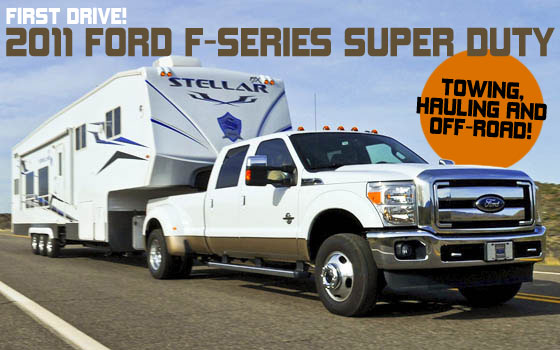
2011 Ford F-Series Super Duty Introduction

You don’t have to skip to the end of this review to find out our opinion of Ford’s 2011 F-Series Super Duty pickups. At this moment, there’s no doubt that Ford has once again raised the bar to new levels of performance and productivity for heavy-duty pickups. The Super Duty continues to be the standard against which its competition will be measured. Read on and find out why.

HD pickups are the workhorses of the truck world, and like pack animals that farmers used to depend on to deliver their crops to market, when a work truck is out of service it causes more than aggravation — it can cost hard dollars and time. And these trucks are worked hard. Ford says 97 percent of Super Dutys are used for towing, according to Super Duty Marketing Manager Brian Rathsburg.

A $50,000-plus price tag isn’t uncommon today, so two of the most important considerations a buyer might think about before committing their hard-earned cash are: Will this truck be able to perform the jobs that I need it to do, and do I feel confident that it will complete them successfully?

Ford is answering those questions by making many improvements to the Super Duty just three years after its last major update, but its most significant changes include two new gasoline and diesel engines and a new six-speed automatic transmission that’s used for both versions. The ZF six-speed manual transmission has been dropped from the lineup. Both engines have been engineered from scratch. The standard 2-valve 6.2-liter V-8 gas engine develops 385 horsepower (at 5,500 rpm) and 405 pounds-feet of torque (at 4,500 rpm), up from the old 5.4-liter gas V-8’s 300 hp and 365 pounds-feet. But it’s the 4-valve 6.7-liter Power Stroke V-8 diesel engine that’s the darling of the powertrain lineup. It pumps 390 hp (at 2,800 rpm) and a staggering 735 pounds-feet (at 1,600 rpm). Roughly 60 percent of Super Duty pickups are ordered with diesel engines.

Want to read more? Click here for the full article

AND Don’t forget – come to Waldorf Ford on Thursday March 11th at 5pm for your very own Sneak Peek at the 2011 Ford Super Duty. We will have one on display and a specialist on hand to answer your questions. Food, Fun and doorprizes, including $10,000 in Ford Custom Accessories!

Source: Pickuptrucks.com

Need a wash?

Wet, wild, traffic jam.

Luckily, no one on the overpass appears to be driving a convertible

Since winter was a little rough and we are sure your car is way dirty we thought you might want to get it washed. Here is a fun way to get it acomplished, although you have to go to Argentina.

What happens when you combine a flooded underpass, a traffic-jammed overpass, and a passenger train in Buenos Aires, Argentina? You get a real-life Six Flags water attraction. Those people standing near the train tracks? They need towels. Hope everyone up on the road above had their windows closed.

http://www.youtube.com/v/UzGwUhIXLDk&hl=en_US&fs=1&

[Source: YouTube]